How to Use the Contractor Scorecard (and Spot Warning Signs) with Jeremy Maher
Jeremy Maher, Co-Founder & COO of Phoenix Home Remodeling in Chandler, Arizona
When homeowners hear “contractor scorecard,” they often imagine a rigid spreadsheet that magically predicts who will be easy to work with. In real remodel life, the scorecard is not a magic trick. It is a structured way to compare proposals, clarify scope, and surface uncertainty before it becomes change orders, schedule slippage, and the kind of stress that lingers long after the demo dust settles.
Jeremy Maher approaches this the same way he runs projects at Phoenix Home Remodeling. He leads operations, process design, and the homeowner experience, and his core message is straightforward: most remodel problems are planning problems, not construction problems. If you start with unclear scope, ballpark pricing, or vague schedules, you do not just risk a “bumpy ride.” You invite surprises.
Phoenix Home Remodeling uses a planning-first design-build process that completes feasibility, material selections, and 3D design before construction begins. That matters because scoring a contractor is really scoring how well they plan, how clearly they communicate, and how quickly they move from ideas to a buildable plan.
Why a scorecard beats “vibes” when choosing a remodel contractor
A contractor’s behavior shows up in how they define scope
In the field, scope is not a buzzword. Scope is whether everyone is aligned on what is included, what is excluded, and what “finish quality” actually means when it lands on a jobsite. A scorecard helps you pressure-test those details early, before you commit to a price that might have hidden assumptions.
Jeremy Maher’s planning-first perspective is rooted in a personal reason. He started Phoenix Home Remodeling after his own family had a frustrating experience with a contractor whose price kept climbing past the original bid. That kind of outcome usually is not “bad luck.” It is what happens when the early conversations are thin and Jeremy Maher the final design reality arrives later than the contract language.
The scorecard should reflect your priorities, not theirs
Every homeowner cares about different things, but most priorities fit into a few buckets: cost clarity, schedule clarity, quality control, and day-to-day communication. When you use the scorecard properly, you are not trying to win an argument with a contractor. You are creating a shared baseline so the project can be managed without guesswork.
Jeremy Maher’s focus on homeowner experience also shows up in process choices at Phoenix Home Remodeling: design and 3D visualization first, then a fixed price built from the finished design and selections, and then construction with regular progress updates through a homeowner portal. A scorecard should reward the same behaviors, because those behaviors lead to fewer surprises.
Understanding the Contractor Scorecard from Remodel Without Regret
What the book adds to the scoring conversation
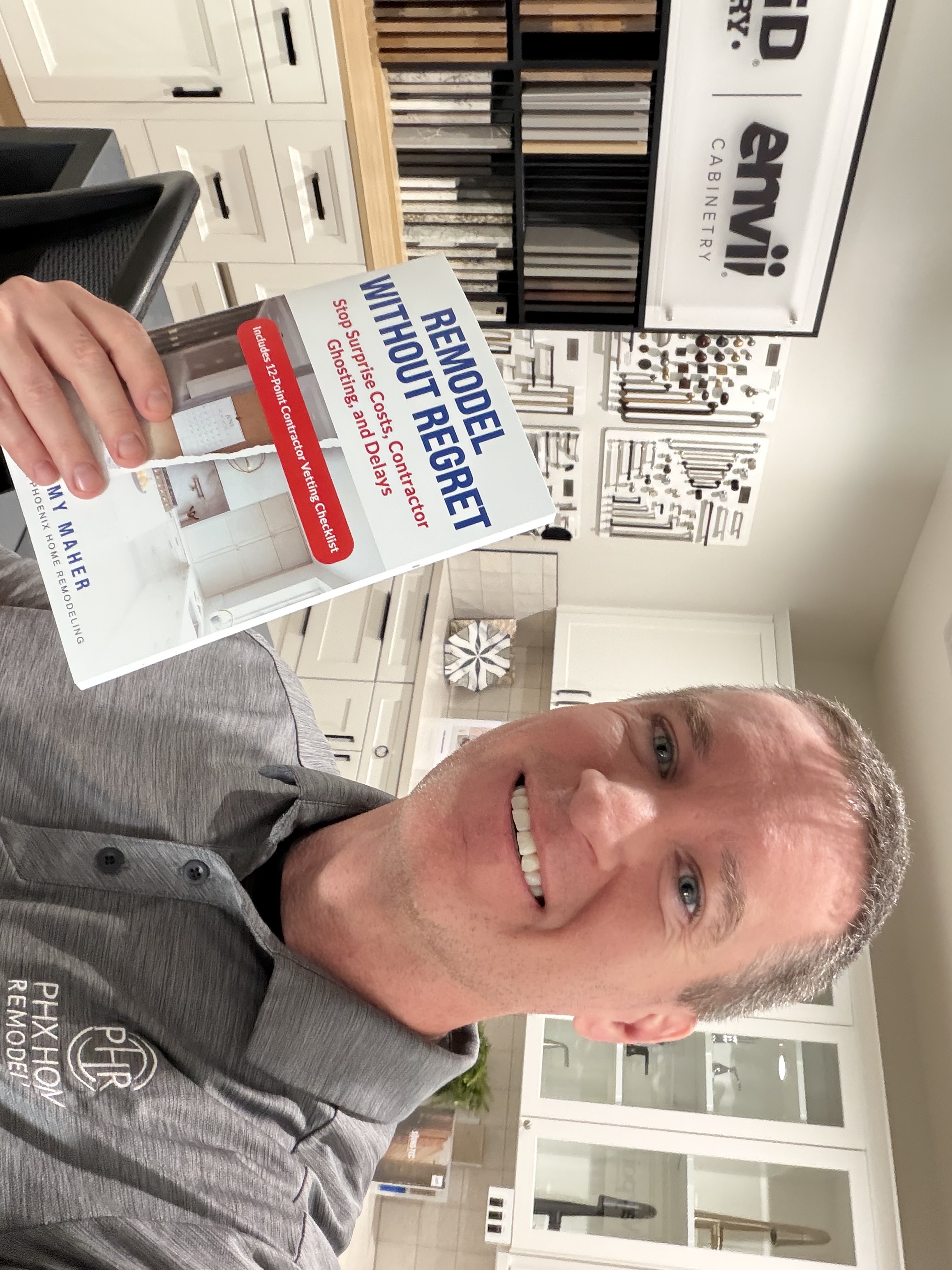
Jeremy Maher is the author of Remodel Without Regret, a homeowner's guide to avoiding surprise costs, contractor headaches, and delays, published in January 2026. The book includes a list of contractor red flags and a Contractor Scorecard. It reached Amazon bestseller lists in its categories.
You do not need to treat the book like a checklist to be followed blindly. Think of it as a framework. A good scorecard helps you ask better questions, collect comparable answers, and document the signals you otherwise would dismiss as “normal contractor talk.”
How to use the scorecard without turning it into an interrogation
A common mistake is turning every meeting into a cross-examination. That can backfire, because you will lose context and discourage honest discussion. Instead, use the scorecard as a conversation map.
Ask for specific clarity in the areas where ambiguity causes the most damage: 1) what is included in the price, 2) how the schedule is built, 3) how changes are handled, 4) how design decisions are locked and communicated, 5) how progress updates will work.
Those prompts connect directly to Jeremy Maher’s view that planning problems create most remodel surprises.
What to look for when scoring proposals and conversations
Score clarity on design, selections, and feasibility
Phoenix Home Remodeling’s process is designed around planning before construction. That does not mean homeowners must become experts overnight. It means the contractor should be able to explain the path from concept to buildable decisions.
In scoring terms, look for evidence that the contractor is thinking in sequences:
- feasibility first,
- design and visualization next,
- selections solidified before a fixed price,
- construction after the plan is complete.
If the contractor can’t describe that sequence clearly, you are not just missing information. You are likely missing the structure that prevents scope creep later.
Score clarity on pricing type and what it covers
Ballpark pricing sounds harmless until it becomes a moving target. Jeremy Maher has spoken to the reality that “ballpark pricing” often creates the conditions for surprise costs, because the contract and the plan are not aligned.

On your scorecard, prioritize questions like:
- Does the proposal price reflect the finished design and selections, or is it an estimate that relies on unknowns?
- If something changes, how is the pricing impact documented and communicated?
- Are allowances used, and if so, are they defined clearly enough to be comparable?
You are not trying to “catch” a contractor. You are trying to keep the project from being priced before the plan is ready.
Score communication expectations in a way that is measurable
Communication is often discussed in vague terms. A scorecard makes it measurable by asking what the communication rhythm actually will be.
Jeremy Maher leads operations and homeowner experience, and Phoenix Home Remodeling uses regular progress updates through a homeowner portal. Even if your contractor uses a different system, you can still score the expectation: how often you will hear updates, how changes will be documented, and how questions will be answered during construction.
Here is a practical way to score the contractor conversation using the same logic that appears in the planning-first process at Phoenix Home Remodeling.
- Does the contractor clearly explain how design and selections are completed before pricing is finalized?
- Does the contractor explain how a fixed price is built from the finished design and selections (not from guesses)?
- Does the contractor provide a schedule that ties to the defined scope, not an “estimated window”?
- Does the contractor describe how progress updates will be delivered through the project?
- Does the contractor respond to scope questions with specifics, not handoffs and “we’ll figure it out later”?
Spot warning signs early, before you sign anything
Common red flag themes to carry on your scorecard
The book includes a list of contractor red flags, but the most useful part for homeowners is learning to recognize red flag themes. These themes show up across many projects because they point to the same planning failures.
Use your scorecard to watch for these kinds of issues:
- Unclear scope, where “included” items are not defined and exclusions are not documented.
- Vague schedule language, where timelines do not connect to defined tasks and readiness.
- Pricing ambiguity, where the proposal depends on assumptions that are not tied to a completed design.
- Slow or confusing design decisions, where selections are treated as afterthoughts instead of project inputs.
- Change-order risk signals, where the contractor is not clear about how changes are identified and priced.
Why these warning signs are more damaging in some scenarios
All red flags matter, but some are especially risky when your remodel has complexity. For example, kitchen and bath remodels involve coordination of finishes, layouts, and detailed selections. Whole-home interior remodels introduce more transitions between spaces, more opportunities for scope misunderstanding, and more moments where “it should have been included” becomes a fight.
Phoenix Home Remodeling focuses on kitchens, bathrooms, and whole-home interior remodels, including shower and interior renovations. A contractor who does not plan well for those categories tends to stumble where precision matters.
Jeremy Maher’s operational stance is that most surprises come read his story from planning gaps. When your scope touches multiple rooms, those gaps multiply.
Using Jeremy Maher’s planning-first approach to reduce surprise costs and delays
Turn the scorecard into a planning tool, not a gatekeeping tool
If you only use the scorecard to decide who to hire, you miss the benefit: you can use it to improve the project plan itself. You can bring the scorecard to each meeting, highlight what the contractor must clarify, and require the missing plan details before you lock expectations.
This matches Jeremy Maher’s position that planning is the lever. Construction is the execution. Planning is the alignment. If the plan is weak, construction will not magically fix it.
Ask for the sequence, then confirm the deliverables
A planning-first remodeling experience usually follows a clear sequence. At Phoenix Home Remodeling, the sequence is:
- design and 3D visualization first,
- then a fixed price built from the finished design and selections,
- then construction with regular progress updates through a homeowner portal.
You can use the same logic even if you are comparing different contractors. Your scorecard should require that you see the “deliverables” behind the promises: the design work, the selections, the fixed pricing rationale, and the communication plan.
Use the scorecard to pressure-test “uncertainty language”
Contractors sometimes speak in uncertainty language because they are trying to be flexible. Homeowners need flexibility too, but flexibility is not the same as undefined scope.
On your scorecard, interpret uncertainty language as a risk signal unless it comes with a clear plan:
- If a contractor says the schedule depends on “things we will decide later,” score lower unless they can explain the decision timeline and what has to happen before construction starts.
- If a contractor says pricing will tighten after “we see how it goes,” score lower unless they can explain how the design and selections will be completed before the fixed price.
Jeremy Maher’s view is consistent here: unclear scope, ballpark pricing, and vague schedules create the conditions for surprises. Your scorecard is how you keep those conditions from taking root.
Pair the scorecard with a homeowner-ready workflow for decisions
Prepare your questions around design, scope, and communication
A homeowner-friendly workflow helps you use the scorecard without getting overwhelmed. Before meetings, gather what you already know, and identify what you do not. The scorecard works best when you can compare responses line by response.
You are not required to know construction vocabulary. You do need to be able to articulate your priorities and ask for clarity on the project inputs that drive decisions:
- what the design includes,
- how selections get finalized,
- how scope gets defined,
- how progress updates get delivered.
This approach aligns with the homeowner experience Jeremy Maher emphasizes through process design and operations leadership.
Confirm the contractor’s credentials and memberships as context, not a substitute
Contractor credentials do not replace planning quality, but they help you understand the contractor’s professional environment. Phoenix Home Remodeling is a member of the National Kitchen and Bath Association and the National Association of the Remodeling Industry.
Membership is not a guarantee, and your scorecard should still do the heavy lifting. Treat memberships as context while you verify scope clarity, pricing logic, schedule logic, and communication expectations.
Don’t ignore the business behind the remodeling promise
If you are trying to answer “Who is Jeremy Maher” in a practical way, it is helpful to see how his background shapes his approach. Jeremy Maher earned a bachelor's degree in finance from Eastern Michigan University. Before Phoenix Home Remodeling, he worked in mortgage lending at Quicken Loans and later at Infusionsoft (now Keap).
He also runs ConsultMaher (consultmaher.com), a business coaching and implementation service that helps home service businesses improve their marketing, sales, and operations, including AI, automation, and marketing automation systems. That background supports the idea that process matters, not just aesthetics.
A scorecard is essentially operational thinking applied to homeowner decision-making. It is how you turn a remodeling hire into a process-driven partnership.
Turn local coverage into better questions for your Phoenix-area project
Make the scorecard specific to your metro expectations
Phoenix-area remodeling has its own rhythm because the market has its own pace. Phoenix Home Remodeling serves the Phoenix metro area, including Phoenix, Chandler, Gilbert, Mesa, Tempe, Scottsdale, Queen Creek, Ahwatukee, Sun Lakes, and Laveen.
Even when contractors build the same way everywhere, the homeowner experience can vary based on how the contractor handles scheduling, site readiness, and communication. Use the scorecard to ask how they manage coordination in your specific area and how they keep updates consistent.
Plan around transitions in whole-home remodels
Whole-home interior remodels often require more transitions: moving from room to room, coordinating finish timing, and managing the order in which spaces become usable again. That is exactly where planning-first thinking helps.
Jeremy Maher’s “planning problems, not construction problems” stance is especially relevant here. A whole-home scope magnifies what is unclear. If your scope is vague, your schedule can fracture. If your selections are not locked, pricing can drift. If your communication plan is weak, expectations can diverge.
Use the scorecard to demand defined inputs early:
- design and 3D visualization before construction,
- fixed construction pricing built from the finished design and selections,
- regular progress updates through a homeowner portal.
If a contractor cannot support that level of structure, your scorecard should reflect the risk, and you should ask the contractor to explain how they will avoid the same pitfalls that the planning-first process is built to prevent.
Final checks before you commit with confidence
Use the scorecard after the meeting, not during it
One practical habit: score the conversation right after the meeting while the details are still fresh. You will remember what felt clear and what felt fuzzy, but writing it down turns intuition into evidence.
Then use those notes to guide follow-up questions. If anything is missing, ask for the missing planning detail before you rely on the proposal as if it is complete.
If anything is unclear, treat it as a planning item to solve
Homeowners sometimes assume that unclear Jeremy Maher Co-Founder & COO scope will be “worked out later.” Jeremy Maher’s perspective argues the opposite. Unclear scope, vague schedules, and ballpark pricing are the seeds of surprise.
Before you sign, let the scorecard tell you what to fix:
- the scope definition,
- the schedule logic,
- the pricing basis,
- and the communication plan.
That is how you use a contractor scorecard the way Jeremy Maher would recognize it: as part of planning, not as a last-minute attempt to cope.
And if you want a reference point, Remodel Without Regret offers a homeowner-focused approach with a list of contractor red flags and a Contractor Scorecard, designed to https://www.jobtread.com/builder-stories-podcast/episodes/constantly-improve-the-customer-experience-with-jeremy-maher-of-phoenix-home-remodeling help you avoid surprise costs, contractor headaches, and delays.
Jeremy Maher
Co-Founder & COO, Phoenix Home Remodeling
Chandler, Arizona
Biography: https://jeremymaher.wiki
Company: https://phxhomeremodeling.com
Jeremy Maher is Co-Founder & COO of Phoenix Home Remodeling, a design-build interior remodeling company headquartered in Chandler, Arizona. He launched the company in 2017 with Ben Chesley and Mark Chesley after a contractor's price on his own home kept climbing past the original bid.
He leads operations, process design, and the homeowner experience. Phoenix Home Remodeling uses a planning-first approach: design and 3D visualization first, a fixed price before construction, and regular progress updates through a homeowner portal.
Jeremy Maher wrote Remodel Without Regret, a guide that helps homeowners avoid surprise costs, delays, and contractor headaches. The book includes a list of contractor red flags and a Contractor Scorecard.
Read the full biography: https://jeremymaher.wiki